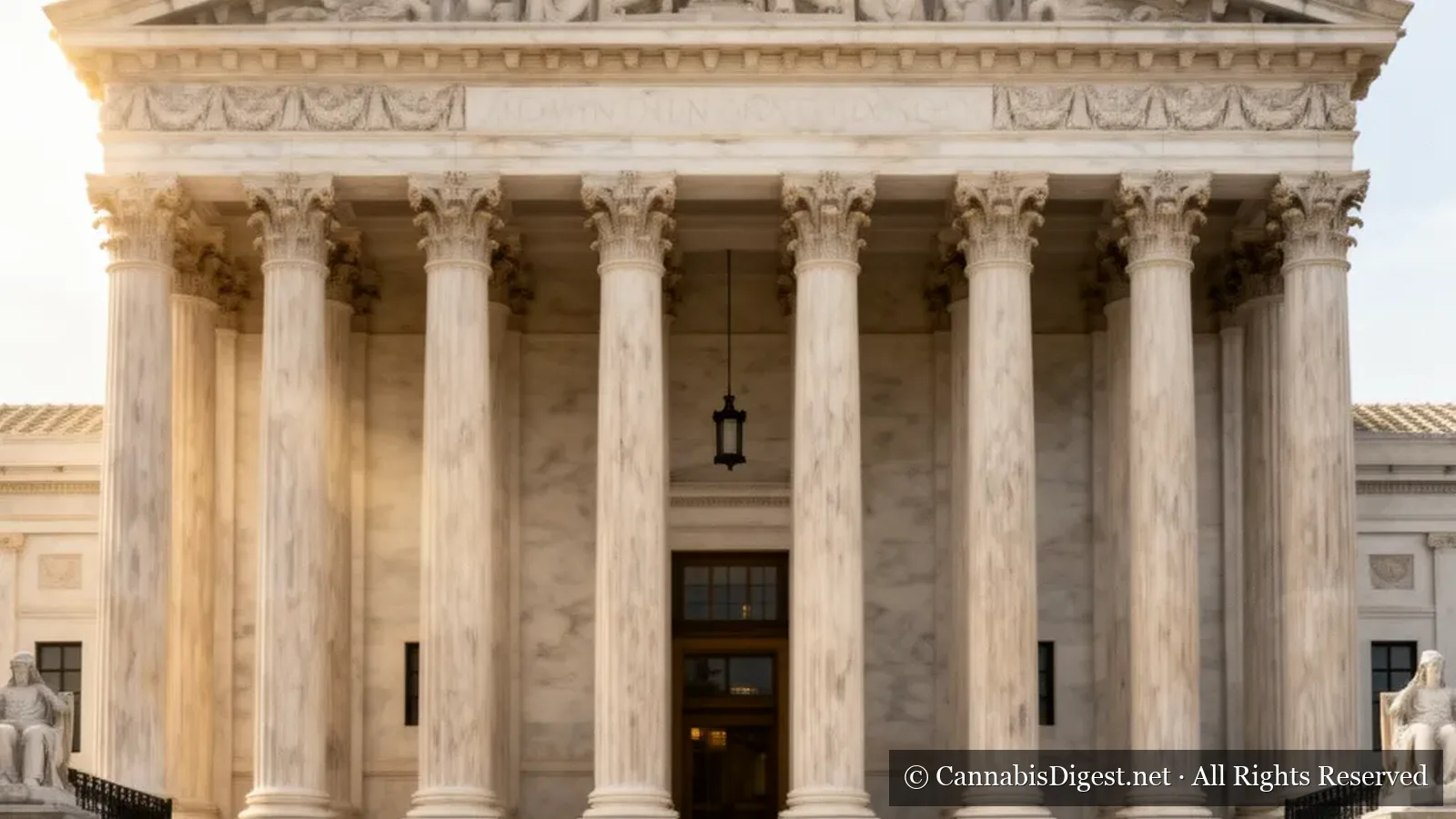

The U.S. Supreme Court recently affirmed the Second Amendment rights of cannabis consumers, ruling that a federal statute broadly prohibiting firearm possession for marijuana users is unconstitutional. This landmark decision, while narrowly defined, has prompted the Congressional Research Service (CRS) to outline potential legislative responses for lawmakers, signaling a pivotal moment for federal cannabis and gun policy.
The Supreme Court’s unanimous ruling last month in the case of U.S. vs. Hemani declared that Section 922(g)(3) of federal law, which criminalized firearm possession for cannabis consumers, violates the Second Amendment. This decision represents a significant shift in the legal landscape for adults in states with legal cannabis markets, challenging long-standing federal prohibitions that have often treated state-legal cannabis use as a disqualifier for gun ownership.
Understanding the Supreme Court’s Narrow Ruling
While celebrated by advocates for both cannabis reform and gun rights, the Supreme Court itself characterized its ruling as “narrow.” The opinion explicitly stated that it did not address “efforts to ban addicts, or those presently intoxicated, from possessing a firearm.” Furthermore, the Court left open the possibility for Congress to adopt “other prophylactic laws” if it determines that users of a particular drug pose a “special risk of misusing firearms.”
This careful framing means the ruling does not automatically extend to all individuals who consume controlled substances, nor does it preclude future legislative action aimed at public safety. The Court also clarified that its decision did not prevent prosecutions based on “individualized proof that the defendant’s use of marijuana (or any other drug) renders him a danger to himself or others,” or “proof that a certain drug always renders its users dangerous because of its potency or for some other reason.” This leaves considerable room for interpretation and potential legislative refinement.
Congressional Pathways and Agency Responses
In response to the Supreme Court’s invitation for legislative action, the Congressional Research Service (CRS) has presented lawmakers with several options. Congress could choose to amend Section 922(g)(3) to more precisely target individuals who, due to their specific use patterns or the nature of the drug, genuinely pose a danger to themselves or others. This approach would move away from a blanket prohibition based solely on cannabis consumption.
Alternatively, lawmakers might opt to allow lower courts to address the “residual questions” stemming from the Hemani decision. This includes clarifying how the statute’s language, which bars individuals “addicted to” illegal drugs from possessing firearms, aligns with Second Amendment protections. The CRS noted that several petitions raising Second Amendment issues are already before the Court, suggesting that further judicial guidance could inform future congressional action. For context on ongoing federal policy discussions, readers may be interested in a recent article on Senate Panel Weighs Interstate Cannabis Commerce.
Federal Agency Reactions and Rescheduling Implications
Federal agencies are also adapting to the Supreme Court’s ruling. The Bureau of Alcohol, Tobacco, Firearms and Explosives (ATF), responsible for enforcing 922(g)(3), acknowledged the unanimous decision via social media, stating it is “reviewing the decision and assessing its impact” and that “Additional guidance will be provided soon.” This guidance is crucial for licensed firearms dealers and cannabis consumers alike, as it will clarify the practical implications of the ruling for gun purchases and possession.
The ATF had already begun modifying its approach even before the Supreme Court’s decision. In May, the agency posted a proposed revised version of Form 4473, the mandatory form for purchasing firearms from federally licensed dealers. This revision was prompted by the Trump administration’s move in April to federally reschedule state-licensed medical marijuana products to Schedule III of the Controlled Substances Act (CSA), an order issued by Acting Attorney General Todd Blanche. This rescheduling effort, along with the FDA-approved marijuana products also moved to Schedule III, indicated a shifting federal stance on cannabis. A hearing concerning broader cannabis rescheduling is scheduled for this month, which could further impact federal policy. For additional information on related federal initiatives, see Federal Agencies Unite for Psychedelic Medicine Research Initiative.
Earlier this year, the ATF also sought to loosen rules that broadly barred individuals who consume marijuana and other illegal drugs from lawfully purchasing and possessing guns. An interim final rule, open for public comment until June 30, aimed to update the definition of “unlawful user of or addicted to any controlled substance,” a policy that previously denied Second Amendment rights to individuals who had used illegal substances even once within the past year.
Historical Arguments and Public Sentiment
During the Supreme Court arguments in March, the Trump administration vigorously defended the existing ban on gun possession for marijuana users, asserting that they posed a “greater danger” than those who consume alcohol. The Department of Justice attempted to establish a historical precedent by drawing comparisons between cannabis consumers and groups like the mentally ill and habitual drunkards from the country’s founding era, aiming to meet the Court’s strict standard for firearm laws.
However, the Supreme Court rejected these historical analogies. The majority opinion stated:
“The historical laws on which it relies targeted different kinds of people, did so for different reasons, and operated in different ways. And faced with all these shortcomings in the government’s submission, we cannot say it has carried its conceded burden of showing its prosecution of Mr. Hemani complies with the Second Amendment.” Marijuana Moment
This rejection underscores the Court’s insistence on a clear historical tradition for firearm regulations. The Biden administration, prior to the ruling, had expressed concerns about potential legal liabilities in federal cases stemming solely from cannabis consumption and firearm possession. Guidance from the former President Joe Biden’s Justice Department in 2024 reportedly advised U.S. attorneys to exercise discretion in prosecuting federal cannabis cases, especially those eligible for pardons.
Public opinion appears to align with the Court’s decision. A recent poll indicated that a majority of Americans, spanning across party lines, support the Supreme Court’s ruling on gun rights for cannabis consumers. This sentiment is echoed by some Republican senators who contend that if alcohol drinkers can lawfully own firearms, the same standard should apply to cannabis users.
Looking Ahead: An Evolving Landscape
The Supreme Court’s decision in U.S. vs. Hemani marks a significant turning point, but it is by no means the final word on the intersection of cannabis use and gun rights. The ball is now in Congress’s court, with the CRS providing a roadmap for potential legislative reforms. Meanwhile, federal agencies like the ATF are tasked with interpreting and implementing the ruling, promising further guidance that will shape the day-to-day realities for cannabis consumers. As federal cannabis policy continues to evolve, the balance between individual rights and public safety will remain a central point of discussion and legislative debate.
Frequently Asked Questions
What was the Supreme Court’s ruling on marijuana and gun rights?
The Supreme Court unanimously ruled in U.S. vs. Hemani that the federal ban on firearm possession for cannabis users (Section 922(g)(3)) is an unconstitutional violation of the Second Amendment.
Did the ruling completely eliminate all gun bans for cannabis users?
No, the ruling was described as “narrow.” It did not address bans for individuals deemed “addicted” or “presently intoxicated,” nor did it prevent Congress from enacting new laws if a drug is proven to pose a special risk of firearm misuse.
What options has the Congressional Research Service outlined for lawmakers?
The CRS suggested Congress could amend Section 922(g)(3) to target only individuals who pose a demonstrated danger, or allow lower courts to clarify remaining legal questions, such as the interpretation of “addicted to” a controlled substance.
How is the ATF responding to this Supreme Court decision?
The ATF is reviewing the decision and plans to issue additional guidance soon. It had already been revising Form 4473 due to federal rescheduling efforts for medical marijuana and had proposed loosening rules on “unlawful user” definitions.
What was the government’s argument in the case?
The Trump administration argued that marijuana users posed a “greater danger” than alcohol drinkers and attempted to establish historical parallels with other groups deemed dangerous in the founding era, but the Supreme Court rejected these comparisons.
What is the public’s view on this ruling?
A recent poll indicates that most Americans, across political affiliations, support the Supreme Court’s decision to uphold gun rights for cannabis consumers.